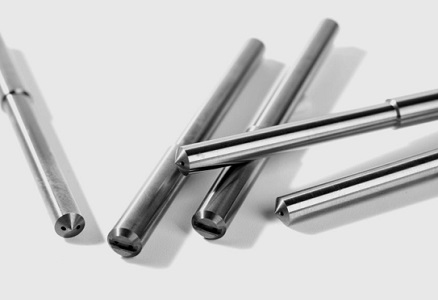
Turning and milling inserts may use similar carbide substrates and coatings, but they are designed for very different cutting conditions. Turning generally creates a continuous cutting action while the workpiece rotates; milling repeatedly engages and disengages the cutting edge as the cutter rotates. As a result, selecting the right carbide insert material requires matching carbide grade, substrate properties, coating technology, and machining requirements to the application.
For production machining, the best insert is not necessarily the hardest grade or the most expensive coating. It is the combination that delivers predictable tool life, chip control, surface quality, and cost per component.
Turning vs. Milling Carbide Machining Inserts: What Is the Difference?
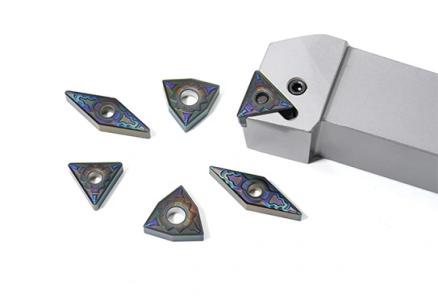
Turning inserts are mounted in a stationary toolholder while the workpiece rotates. Their performance depends on factors including carbide grade, substrate toughness, coating system, and the final insert design developed by tool manufacturers. These features determine cutting-edge strength, chip formation, accessibility, and finishing capability.
Milling inserts rotate with the cutter and repeatedly enter and leave the workpiece. This interrupted cutting action places greater emphasis on edge toughness, secure insert seating, thermal-mechanical stability, and suitable cutting geometry.
In practical terms:
Turning inserts prioritize chip control, dimensional stability, and predictable wear during longitudinal turning, facing, profiling, and boring.
Milling inserts must withstand repeated cutting impacts while maintaining stable performance in face milling, shoulder milling, roughing, and finishing.
The same carbide grade should not automatically be applied to both operations simply because the workpiece material is identical.
When evaluating turning inserts factories or milling inserts manufacturers, buyers should therefore look beyond insert dimensions and confirm that the supplier has application-specific grades and geometries.
How to Choose CNC Carbide Inserts for Turning Operations
A reliable turning insert selection normally begins with four questions: What material is being machined? Is the operation finishing, medium machining, or roughing? How stable is the setup? What chip control and surface finish are required?
Sandvik Coromant similarly recommends selecting turning grades according to workpiece material, machining method, and operating conditions, while considering geometry and grade together.
For example:
Finishing: Choose a sharper geometry and smaller nose radius when low cutting forces and surface quality are priorities.
Medium machining: Use a balanced geometry capable of handling variations in depth of cut while maintaining reliable chip control.
Roughing: Stronger cutting edges and tougher carbide grades are typically required to handle heavier feeds, greater depths of cut, scale, or interruption.
CYC provides carbide grades and material solutions used for turning inserts in steel, stainless steel, cast iron, and high-hardness machining applications.
A capable carbide insert supplier should also ask for cutting speed, feed, depth of cut, coolant condition, machine rigidity, and current failure mode before recommending a replacement insert.
Selecting Milling Inserts for Stable and Efficient CNC Machining
Milling insert selection starts with the machining operation: face milling, shoulder milling, slotting, profiling, or another application. Cutter diameter, number of teeth, entering angle, engagement, machine power, and workpiece stability all influence the insert requirement.
For milling, geometry becomes especially important because cutting forces vary as each edge enters and exits the material. Positive, light-cutting geometries can reduce cutting forces, while stronger geometries are often preferred when edge security is more important. Sandvik notes that positive, sharp insert geometries can reduce cutting forces in appropriate milling applications.
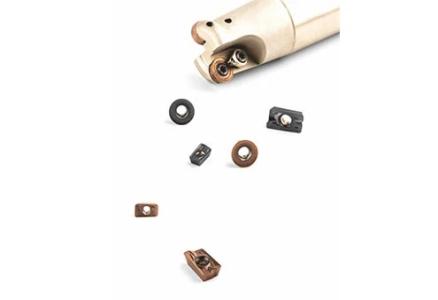
CYC's milling range includes CNC carbide inserts designed for roughing, semi-finishing, and finishing, with geometries intended to support chip evacuation and tool life across different machining conditions.
When comparing milling inserts manufacturers, industrial users should evaluate:
Grade options for different workpiece groups
Roughing and finishing geometries
Edge preparation consistency
PVD and CVD coating capability
Dimensional repeatability
Batch-to-batch performance
Technical support for cutting parameter optimization
These factors have a greater effect on long-term machining economics than unit price alone.
Matching CNC Insert Material, Grade and Coating to the Workpiece
Selecting the correct carbide material requires balancing wear resistance, toughness, thermal stability, and machining requirements. A harder, wear-resistant grade may provide long life under stable conditions, while a tougher grade can provide better edge security when vibration, interrupted cuts, or unstable workholding are present.
Workpiece classification is an effective starting point. Carbide inserts are commonly selected for ISO material groups including steels, stainless steels, cast irons, non-ferrous materials, heat-resistant alloys, and hardened materials. CYC's carbide insert portfolio covers P, M, K, S, N, and H machining applications.
Coating must then be matched to the application rather than selected independently. PVD and CVD coating systems are widely used to improve wear and thermal performance, but substrate, edge geometry, coating, and cutting parameters must function as one system.
This is also where experienced carbide insert suppliers add value. Instead of simply cross-referencing an ISO insert code, they can recommend a complete grade-and-geometry combination based on the customer's actual failure mode.
FAQs About Turning and Milling Carbide Inserts
Can milling inserts be used for turning?
Generally, inserts should be used for the machining operation and cutter system for which they were designed. Although some insert shapes may appear similar, turning and milling create different cutting loads, clamping requirements, and edge conditions. Using the specified insert family provides better process reliability.
How do I know which carbide insert grade to choose?
Start with the workpiece material, then consider whether the operation is finishing, medium machining, or roughing and whether the machining conditions are stable or difficult. Insert geometry and grade should be selected together rather than independently.
What makes a good carbide insert for finishing?
A finishing insert normally needs controlled chip formation, a suitable nose radius or cutting geometry, low cutting forces, and a wear-resistant grade capable of maintaining the cutting edge. For face milling, wiper concepts and sharp PVD-coated edges can also be used to improve surface finish in suitable applications.
Why do carbide inserts chip during milling?
Common causes include excessive cutting load, vibration, an insert grade that is too brittle, incorrect geometry, unstable workholding, or unsuitable cutting parameters. Because milling involves repeated edge engagement, toughness and process stability are especially important.
What should buyers ask carbide insert suppliers before placing an order?
Provide the insert specification, workpiece material, machine type, machining operation, cutting speed, feed, depth of cut, coolant condition, required finish, and current tool-life problem. This allows the supplier to recommend suitable carbide grades and material solutions based on the process rather than simply supplying a dimensional match.
For industrial users choosing between turning inserts factories, milling inserts manufacturers, and general carbide insert suppliers, consistent manufacturing and application support should be part of the purchasing decision. CYC provides carbide material solutions for turning, milling, drilling, and other precision insert applications, helping tool manufacturers select suitable grades for different CNC machining requirements.